The emotional anatomy and rhythm of Andy Burnham’s ‘once in a generation’ political speech to Labour Party Conference
How the PM went big on trust, hit us hard with anticipation, kept fear, disgust and anger under control - and went with less, not more, for his big finale.
A communications friend quipped on a WhatsApp group last week that he’d had a comms brief from a political leader to ‘make me Andy Burnham’. He was only half joking!
In comms circles there’s a lot of fanboying/girling/personing over the seemingly innate communication skills of our new PM.
I’m certainly one of those admiring the (re)fresh(ing) new approach. And there’s no shortage of sages giving hot takes on what comms pros - and leaders - can learn from Burnhamism.
I’m of course adding to the pile here!
But this is hopefully a slightly different and useful data-informed take, to help understand why Tuesday’s set piece speech worked so well.
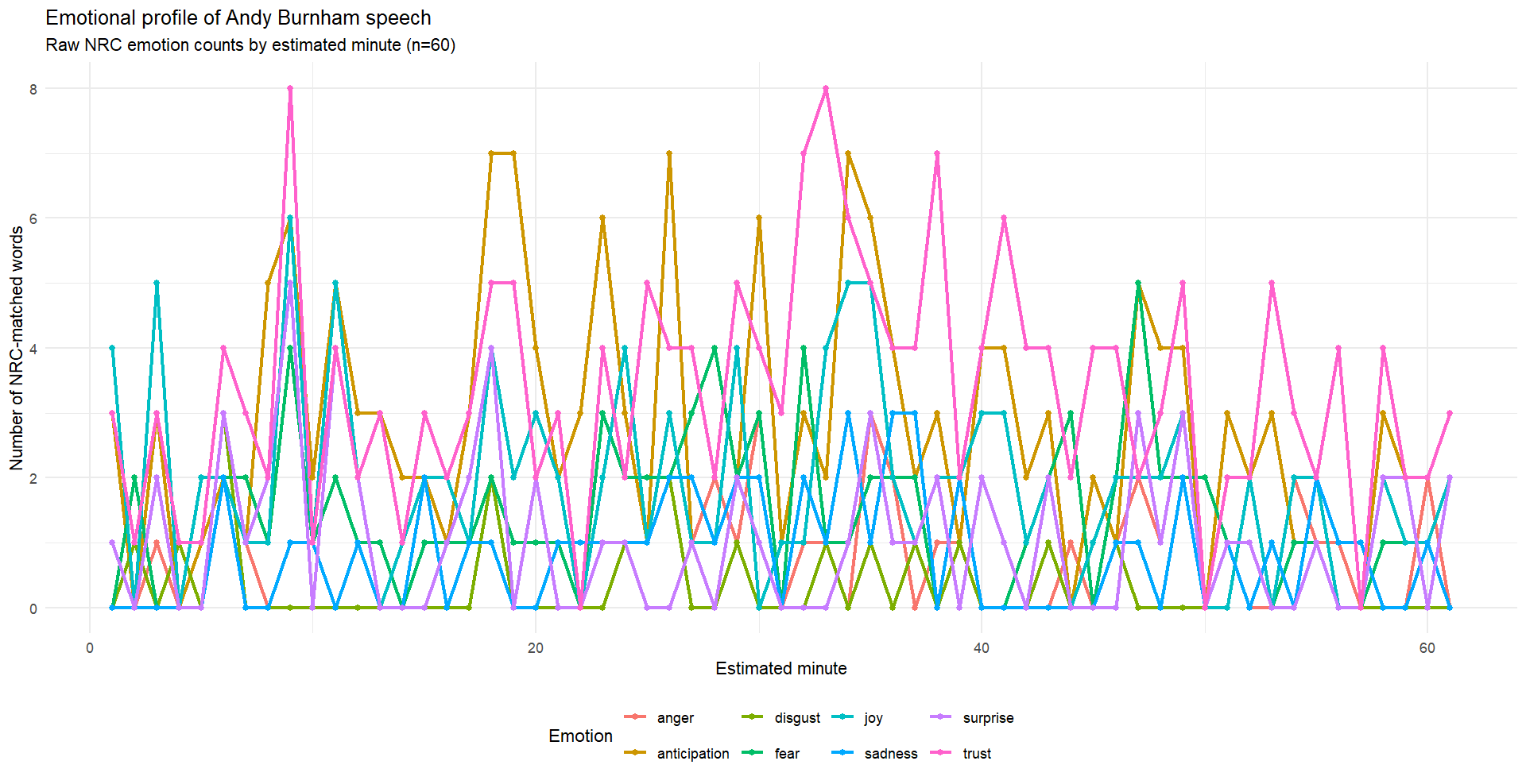
The graph above gives a minute by minute emotional breakdown of the PM’s speech. It draws on something called the NRC Emotion Lexicon - a dictionary of thousands of words that have been assigned an emotional association by humans.
The model measures eight fundamental emotions - anger, fear, anticipation, trust, surprise, sadness, joy, and disgust. Note that words in the lexicon can have multiple emotional designations.
The method I used here is slightly simplistic; to get the breakdown I took the 6,000 words it contained and divided it by the 65 mins length minus an estimated 5 mins for pauses (roughly 100 words per minute).
But it gives is a pretty good idea of the emotional anatomy - and rhythm - of what is being hailed as the best leaders' party conference speech in a generation.
What jumps out for me?
The prominence and dominance of trust-related language throughout
How the middle of the speech was stacked with anticipation and joy
The largely consistent rhythm in the use of different emotions
Sadness, fear and anger were all there - but were never allowed to dominate
The very sparing use of emotion at the end of the speech
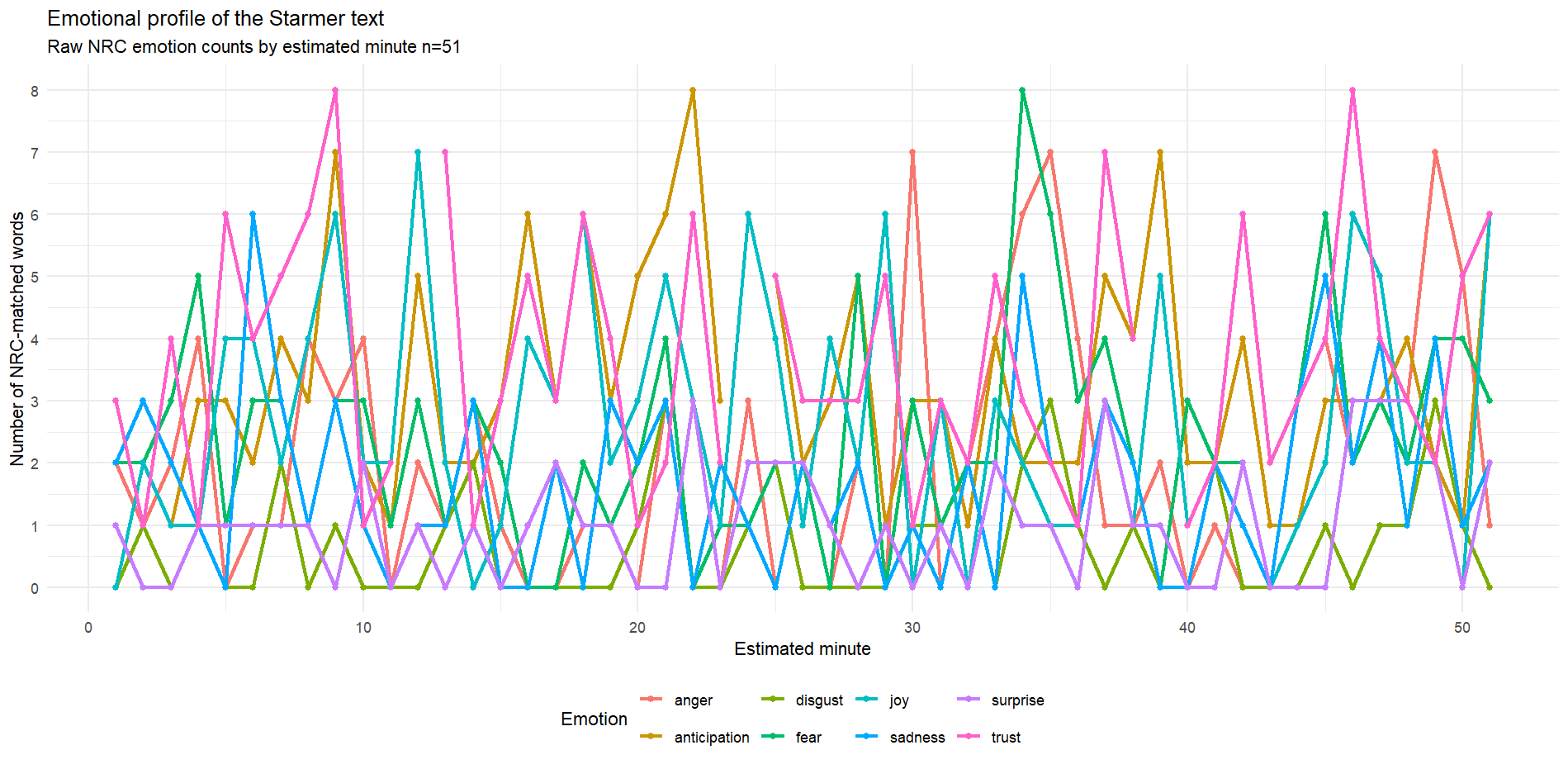
On the last point, it’s also very interesting to compare Burnham’s speech to Keir Starmer’s set piece address 12 months earlier (same technique used to create the graph).
What jumps out for me?
The emotional content is much more chaotic with less ‘rhythm’
Trust is there - but it is always fighting for space with other emotions
The end of the speech is like an emotional firework display
This profile perhaps points to one of the reasons why Keir Starmer had such a problem getting his messages to land.
DM me if you want a higher res version of these graphs, or to chat more about this approach to understanding great communications.
This is an example of the data-informed work I do with progressive comms and PR teams up and down the country, helping them better assess and improve corporate comms, campaigns and storytelling.
Analysis and dataviz done manually in RStudio, with ChatGPT helping me write some of the R code.