

To show comms impact like THIS you’re going to need to get better with data

Thanks to Stephen Waddington for flagging up the excellent Impact Report from Strike Communications Ltd (headed up by Catherine Frankpitt).
And it is an impact report, rather than just an activity report.
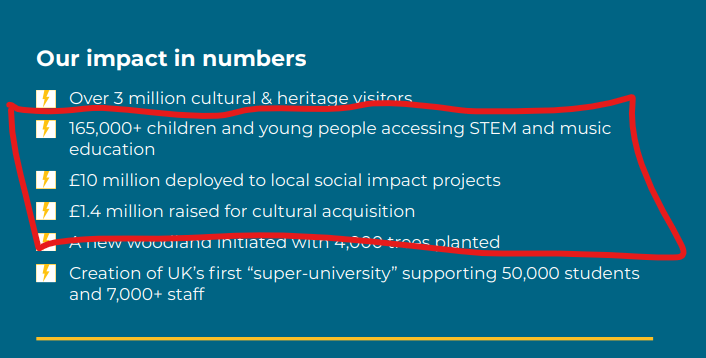
The Strike Communications report does the hard yards and shows actual impact.
While the report does use figures such as media coverage, events held and comms strategies produced, it does not claim this as impact. It labels this as 'work'.
Where it goes further than a lot of similar reports is that it details number of lives improved and financial benefit created. It answers the question you are always left with after reading about large numbers of clicks and coverage, which is 'so what'? and 'what difference did it actually make?'
If you are in a public sector comms team - doing, as Strike does, 'communication for good' - you might be wondering how you can get those type of figures for your own work.
As communicators we are (rightly) concerned with factual accuracy, and I think there is perhaps sometimes a reluctance to put financial or social impact figures on work, in case the basis for it is challenged. I also think a lack of data confidence and litreracy is part of the issue - the old 'I do words, not numbers' chestnut.
I have a few data-specific thoughts on steps you can take to move from output to actual impact in your reporting;
You are busy. But don't rush to put measuring real world impact into the 'too hard' box. It might well be hard. But getting to figures like the ones shown in the report is not impossible. It also builds credibility and shows comms to be a strategic function and not a service.
Think about what different datasets you wil need to show impact very early in your project or campaign - the chances are you won't own all of it, so you'll need to ask/persuade others to give you access.
Once you've determined the key data you'll need to tell your success story (hopefully), take a baseline before you start any activity. Otherwise, you won't know how much something has changed. That might mean looking at year-on-year data as well as month by month.
Demonstrating impact will often require you to make some assumptions; these should be reasonable and defendable. There will also be some limitations to your method of calculating impact. This is okay, but you should record and acknowledge these.
Be careful not to overclaim; if you see strong correlation between your campaign and a real-world outcomes, use phrases like 'very strongly suggests' and 'seems very likely' rather than 'proves'. You should also consider and address alternative explanations (see below).
Part of credible impact reporting is condering what data you don't have and possible other explanations - explore these as part of your impact data gathering, testing some theories (for example, have key figures been decreasing year on year, or could other events/actions/interventions have affected the outcome?).
Don't go it alone. Ask for help and advice from data experts in your organisation or comms peers whose work your admire.